Precise magnetic measurement
Two 1 kg beam load cells capture the force on the left and right and convert it into a stable holding force in grams.

The scale for the magnetic holding force of slot cars. Measure how many grams the magnets pull on the rail – create equal conditions for everyone at your event and reliably sort out tuning magnets.
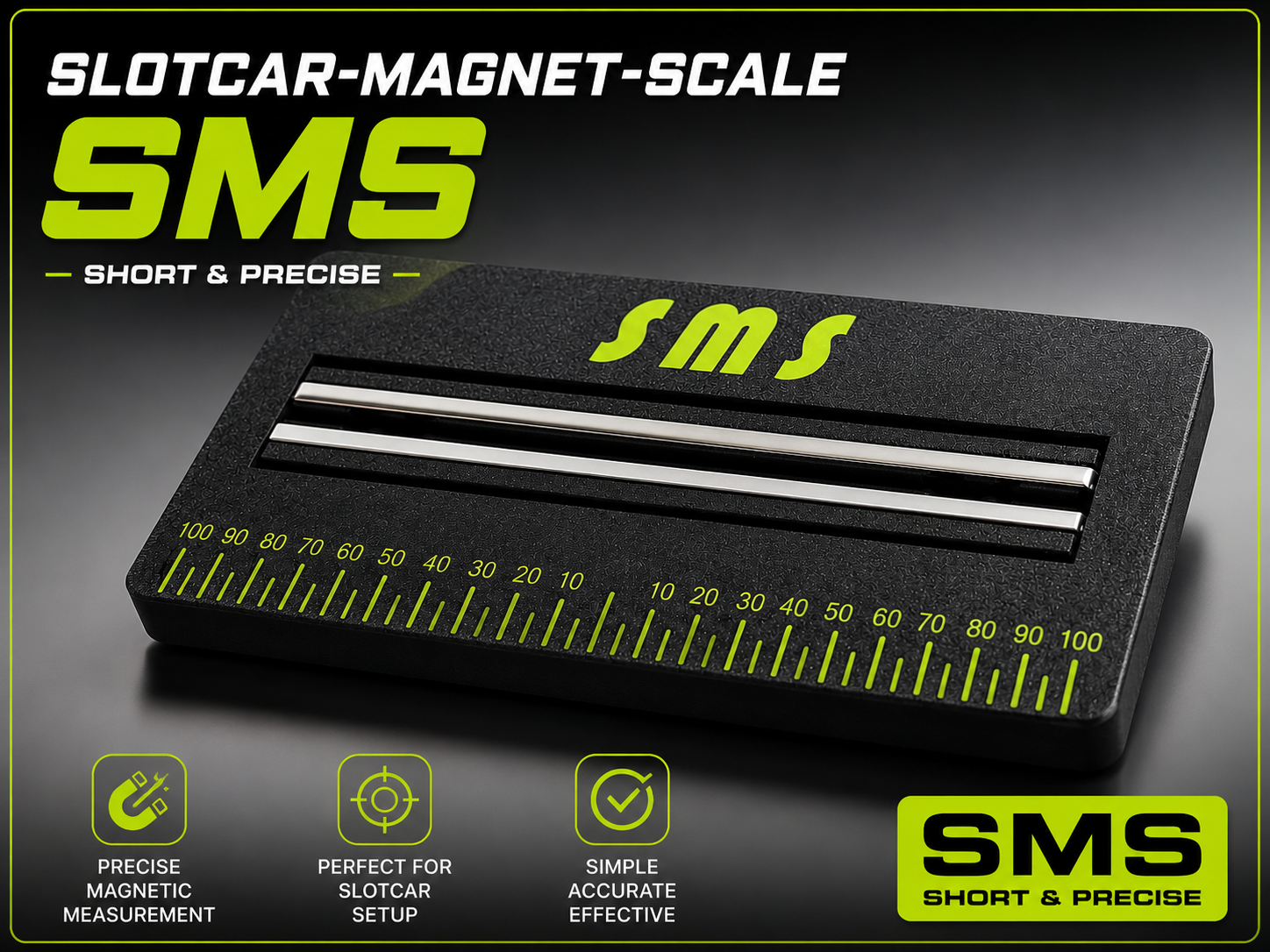
Measure magnetic holding force precisely, reproducibly and right at the track – for equal starting conditions in every race.
Two 1 kg beam load cells capture the force on the left and right and convert it into a stable holding force in grams.
See at a glance how many grams the magnets pull – ideal for comparing and cleanly setting up cars for the event.
Operate the scale conveniently via the web interface or through the serial console at 115200 baud.
Reliably detect magnets that are too strong and create equal conditions at events for fair competition.
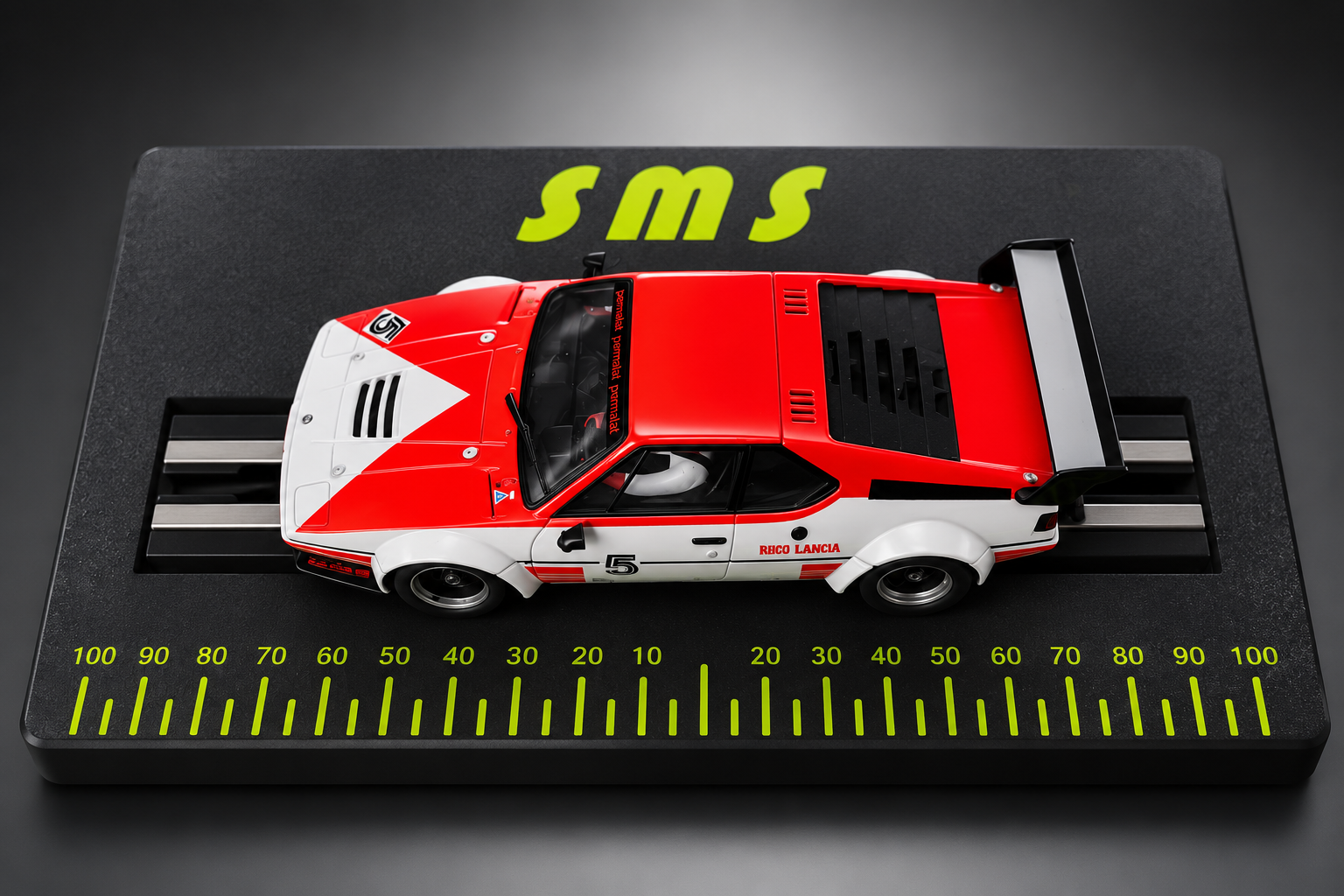
The car rests on two polished steel rails. Both load cells are rigidly connected to the same platform – the magnets pull the car onto the rail, and the total holding force in grams is calculated from a weighted combination of both sensors.
Proven standard components – quick to rebuild and easy to wire.
Capture the force at both ends of the measuring platform.
A 24-bit converter per load cell for precise readings.
ESP8266 board with Wi-Fi – controls and evaluates everything.
Both HX711 modules connect directly to the Wemos D1 mini.
| Signal | Wemos D1 mini |
|---|---|
| DOUT / DT | D1 / GPIO5 |
| SCK / CLK | D2 / GPIO4 |
| VCC | 3V3 |
| GND | GND |
| Signal | Wemos D1 mini |
|---|---|
| DOUT / DT | D5 / GPIO14 |
| SCK / CLK | D6 / GPIO12 |
| VCC | 3V3 |
| GND | GND |
A look at the mechanical build – from the empty, 3D-printed housing to the ready-to-use SMS.
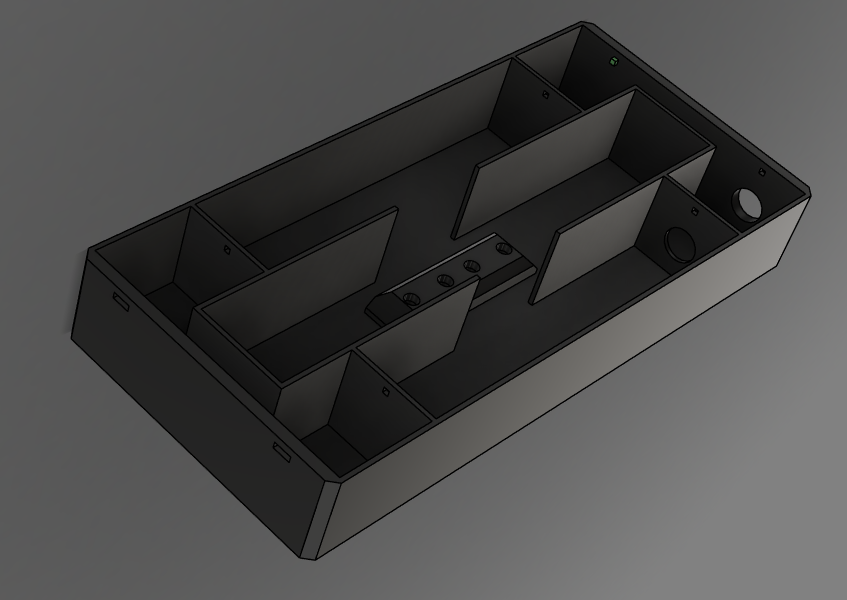
The 3D-printed base housing with compartments for load cells and electronics.
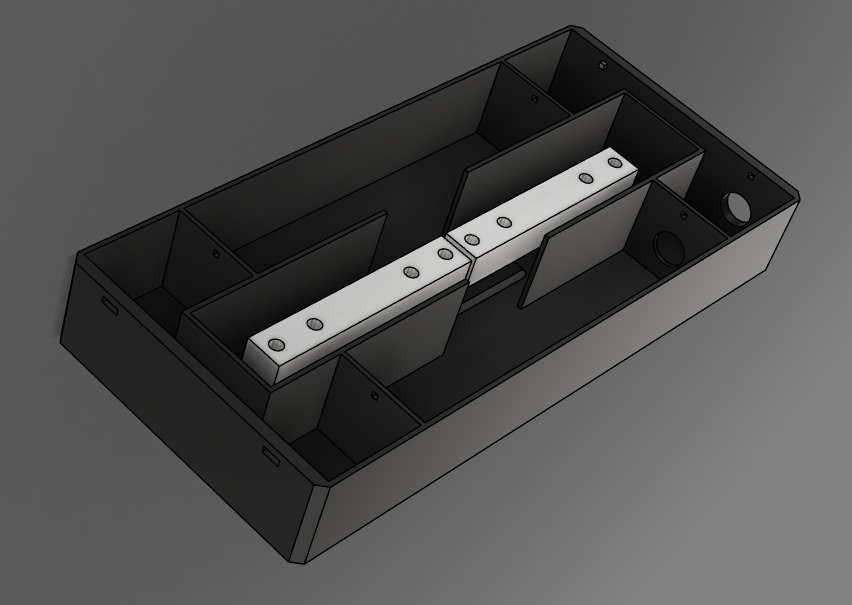
The two 1 kg beam load cells sit centered on the base plate.
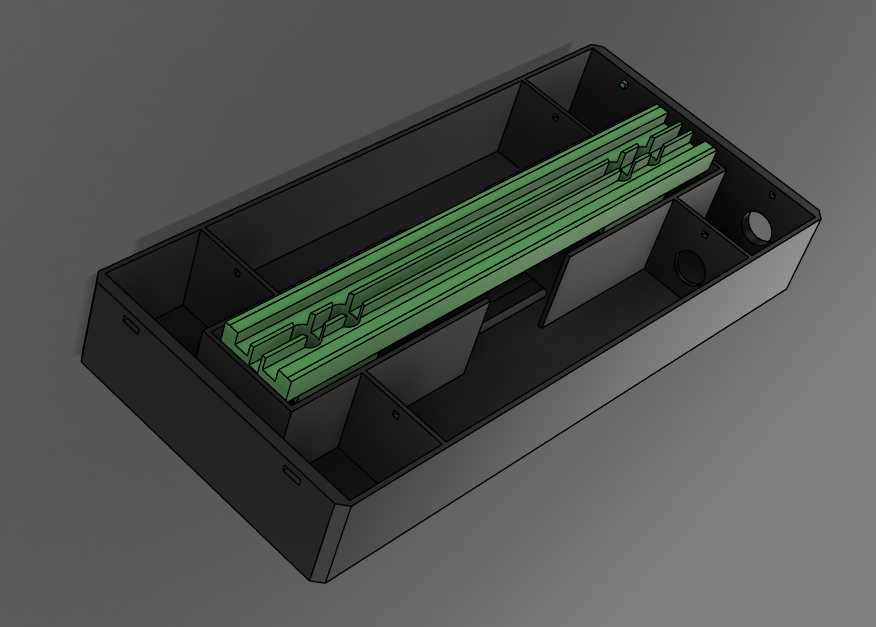
The rail inlay is placed on the load cells – this is where the car rests later.
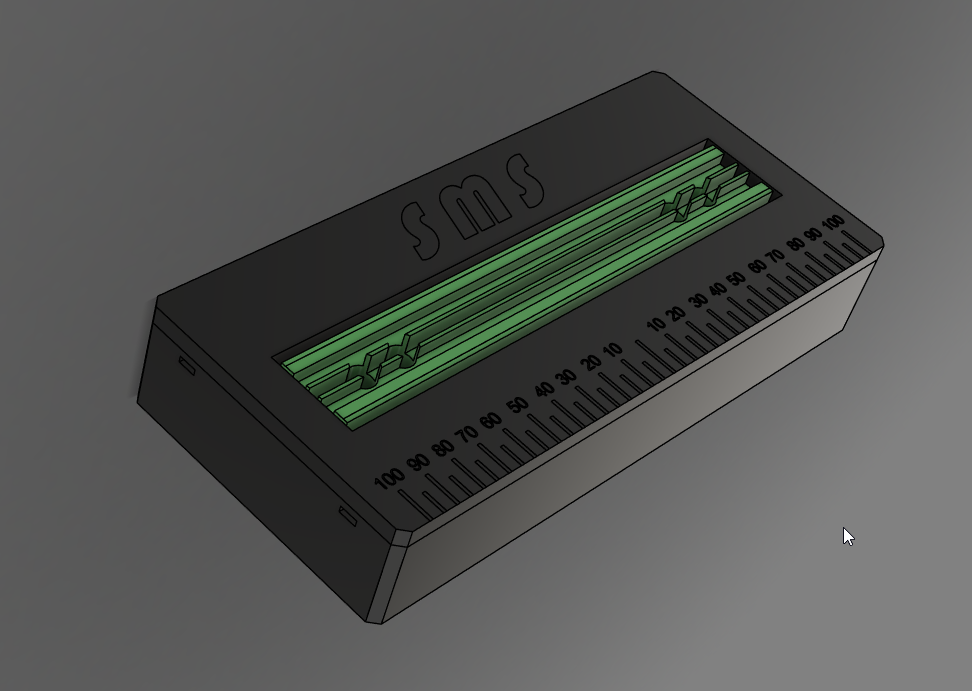
The fully assembled SMS with measuring rails in the black housing.
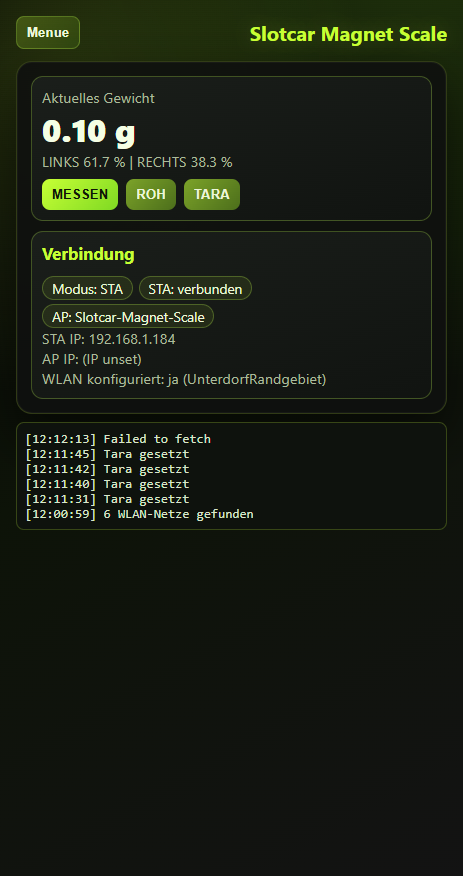
The firmware ships with a modern single-page web interface. Live weight, load distribution, calibration and Wi-Fi settings in one place.
Because both cells sit on a shared platform, calibration is not done per cell but jointly across multiple positions using the same reference weight. The firmware solves the factors using least squares.
Completely unload the platform, then set the tare.
Start with a known reference weight, e.g. 1000 g.
Record the weight at multiple positions (left, center, right).
Calculate the factors – automatically saved to EEPROM.
TARA 20
KAL_START 1000
KAL_PUNKT LINKS 20
KAL_PUNKT MITTE 20
KAL_PUNKT RECHTS 20
KAL_BERECHNEN
MESSEN 10Control the scale entirely from the serial console (115200 baud). A selection of the most important commands.
| Command | Description |
|---|---|
HILFE |
Show help |
STATUS |
Show current status |
WLAN <ssid> <pw> |
Save Wi-Fi credentials |
TARA [n] |
Set tare (optional: n samples) |
KAL_START <g> |
Start calibration session |
KAL_PUNKT <name> |
Record calibration point |
KAL_BERECHNEN |
Calculate and save factors |
MESSEN [n] |
Single measurement |
START [ms] [n] |
Start streaming |
RESET |
Reboot device |
The complete source code and ready-made firmware releases are freely available on GitHub. The 3D print files are on MakerWorld. Flashed onto the Wemos D1 mini in no time with PlatformIO.
An open-source project for the slot racing community.